
Engineered like a benchrest platform.
Built for the realities of long-range hunting.
For years, long-range hunters have optimized barrels, bullets, and optics.
Very few have optimized the platform the rifle sits in, and that is where a significant portion of real-world performance is either gained or lost without the shooter ever realizing it.
Most hunting stocks are built around weight savings and general usability, not precision. The result is a system that is harder to control, less predictable under recoil, and more sensitive to imperfect shooting conditions.
When distance increases, those limitations become exposed.
The Scythian Hunter was built around one objective:
To create the most mechanically thought-out long-range hunting stock possible.
This meant prioritizing:
This is not a styling decision. It is a system design.
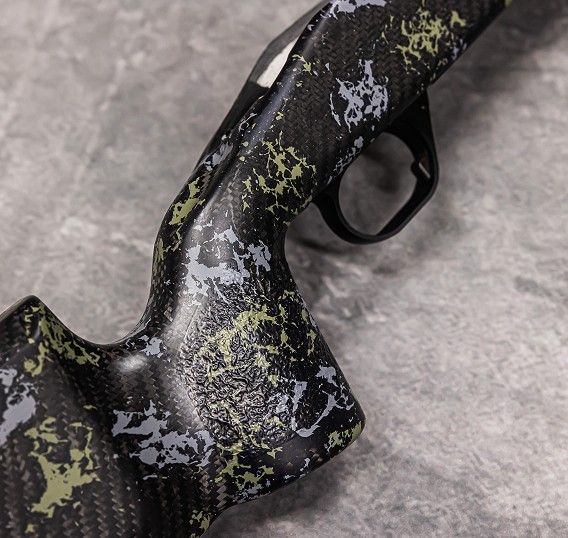
The SCR Scythian Hunter is not a lightweight trend piece.
It is a precision-first hunting platform built for shooters who expect to spot their own impacts and make deliberate follow-up shots at distance.
Every surface, angle, and interface was engineered to reduce variables and stack mechanical advantage in the shooter’s favor under real-world conditions.
This is a system built for control, stability, and repeatable performance when the margin for error disappears.
The Scythians were among the earliest cultures to dominate long-range combat. Their composite bows combined multiple materials—wood, horn, and sinew—into a unified system that outperformed anything of its time. These bows were not designed by accident; they were engineered with intent, balancing strength, flexibility, and efficiency in a way that influenced weapon design for centuries.
The Scythian Hunter carries that same philosophy forward.
It is not a single feature or material that defines its performance, but how every part of the system works together. The geometry, structure, and interfaces are designed with purpose—creating a platform that performs consistently under pressure.
This name is not aesthetic. It reflects design intent.

Each feature of the Scythian Hunter exists to solve a specific problem. The design is not based on appearance or convention—it is based on how the system behaves under recoil and in real-world shooting positions.
When these relationships are not controlled, the system becomes harder to manage, especially as distance increases and conditions become less forgiving.

The sides of the stock are straight and parallel from tang to fore-end. This allows the stock to be held in a mill vise and indicated true before inletting and supports precise bedding and alignment. This is mechanical design, not cosmetic shaping.
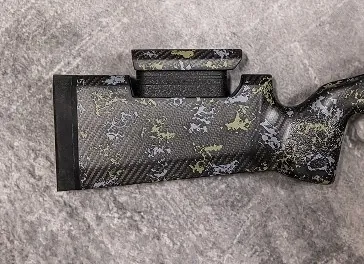
The flatter toe angle reduces muzzle rise and encourages the rifle to track straight rearward under recoil. This allows the shooter to stay in the scope and observe impacts more consistently, especially with higher-recoiling cartridges.
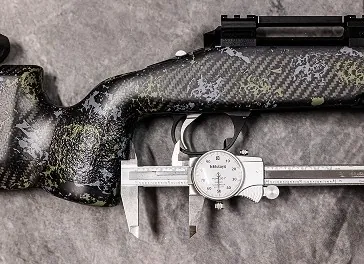
The grip is designed to allow a natural, 90-degree trigger press without forcing wrist tension or extending the index finger. The short grip-to-trigger distance is the shortest in the industry and improves control and repeatability, while the ambidextrous thumb shelf promotes consistent hand placement.

The fully adjustable cheek system allows both vertical and lateral refinement of the shooter’s position behind the optic. This enables a precise, repeatable interface between the shooter and the rifle—something simplified systems cannot achieve. Proper alignment at this interface directly influences consistency at distance.
The Picatinny rail is positioned at the extreme front of the stock, placing the bipod as far forward as possible. This effectively increases the rifle’s wheelbase, improving stability and reducing movement during the shot.
The narrow top of the cheek piece keeps the shooter’s face closer to the bore centerline. This reduces the need for excessive lateral adjustment of the cheek piece and minimizes head cant to get the shooter’s eye directly in line with the optic, improving consistency behind the rifle.
The front portion of the cheek piece remains fixed, allowing full bolt travel on long action bolts without compromising structural integrity of the cheek piece or limiting adjustment. This maintains rigidity while preserving proper alignment with the optic
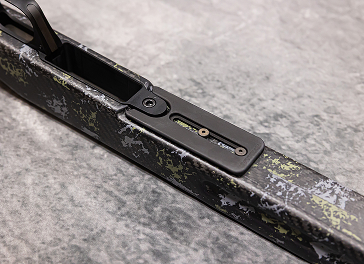
The integrated ARCA rail supports modern tripod use and allows precise balance adjustment. It prevents unwanted movement under recoil and creates a stable interface with tripod systems.
The rear of the stock uses a V-shaped toe with a flat center section to create a repeatable tracking interface in rear bags. This geometry stabilizes recoil direction and improves consistency from supported positions.
The stock tapers tightly around Hawkins M5 bottom metal, creating a clean and direct interface. This supports straight-line movement between the trigger and bolt while allowing easy inspection of fitment.
The stock incorporates a textured grip, a smooth fore-end, and a deep carry groove located near the balance point. This allows for controlled handling in the field without interfering with shooting performance.
The result of these design decisions is a system that behaves differently.
Recoil is controlled and predictable.
The rifle tracks straight back.
The shooter remains in position and can observe impacts.
Corrections can be made quickly and confidently.
This is where forgiveness comes from—not from the shooter working harder, but from the system working correctly.
Without this level of control, the shooter is forced to compensate for the rifle. Under real-world conditions, that often shows up as missed opportunities, inconsistent impacts, and reduced confidence when it matters most.
The Scythian Hunter is designed to function as part of a complete rifle system.
It supports higher-performance cartridges and manages their recoil in a usable way.
It maintains alignment across the action, optic, and shooter interface.
It integrates cleanly with modern accessories and real-world hunting setups.
This is not a standalone component—it is part of a system built to perform under pressure.
The Scythian Hunter is not for everyone.
It is for the hunter who:
This is the stock serious long-range hunters graduate to.
If you’ve ever felt like your rifle should be easier to shoot, more stable, or more predictable—this is where that difference comes from.
The Scythian Hunter is what happens when stock design is treated as a performance system—not a styling decision. Systems built this way behave differently—and once you understand the difference, it’s difficult to go back. Most shooters never experience that difference—because they’ve never used a system built this way.
The Scythian Hunter is available both through SCR and directly through McMillan Stocks, depending on how the system is being built.
SCR carries the Scythian Hunter in short, medium, and long action configurations. These stocks are kept without specific inlet cuts, allowing them to be machined and fitted precisely for the intended action during the build process. This approach ensures a controlled interface and consistent fitment as part of a complete system.
For customers who prefer to purchase the stock as a standalone component, or who are working with another builder, the Scythian Hunter can be ordered directly through McMillan Stocks. McMillan offers the ability to select specific inlets, colors, and configurations based on individual preferences.
Both options exist to support different build paths. When integrated as part of a complete SCR system, the stock is fitted and configured to match the rest of the rifle. When purchased independently, it provides the same design in a more flexible format for custom applications.